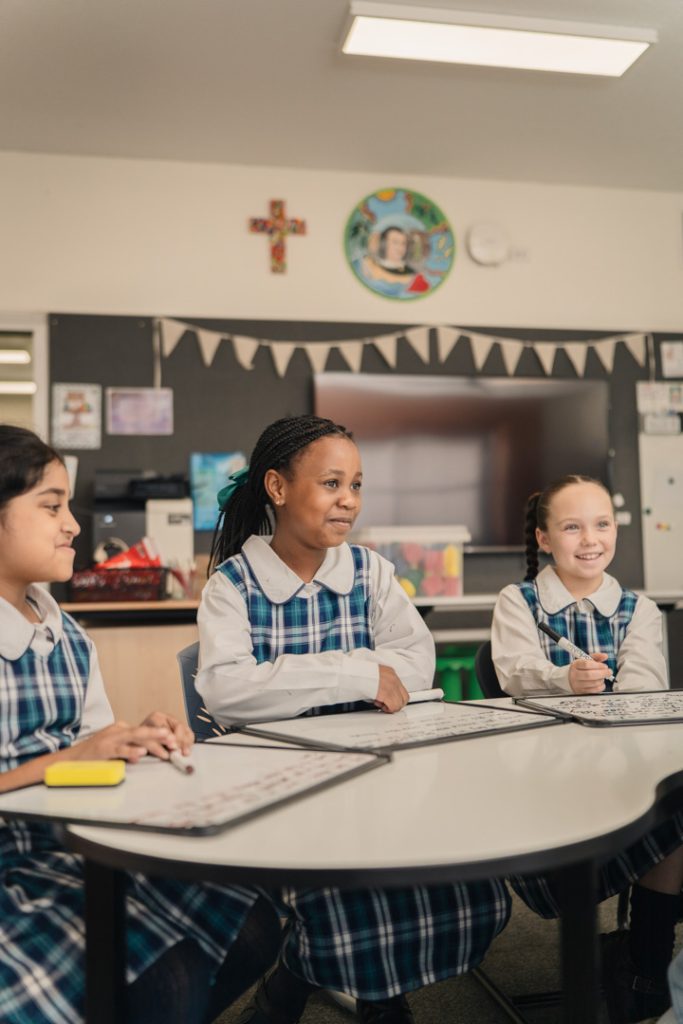
Walk into a Religious Education lesson in our Kindergarten classroom, and you might find children wide-eyed over a story, wondering aloud about God, or quietly drawing what they imagine heaven might look like. Walk into a Year 6 classroom, and you’ll find the same sense of wonder, now paired with real questions, real dialogue, and a growing understanding of what it means to live a life of faith.
“Every child encounters the Good News of Jesus Christ in ways that are meaningful and relevant to their own life and experience.”
That’s the heart of Religious Education at our school: not a subject to be memorised, but a space where every child, whatever their family’s own faith background, is known, valued and supported to flourish.
A place for every family
We recognise that families come to our school with a range of faith backgrounds and experiences, and Religious Education is designed to meet every child where they are. For students already living their Catholic or Christian faith, learning deepens and strengthens that connection. For students from other or no particular faith background, learning invites genuine reflection on what faith and belonging can mean and offers every child a warm introduction to the Catholic tradition and story. Every child engages fully in Religious Education alongside their peers.
How we teach
Our approach is shaped by the Religious Education Curriculum for schools in the Diocese of Maitland-Newcastle, Encountering the Mystery of God.
At its heart is the ‘Pedagogy of Encounter’: students are invited to encounter faith through experience, Scripture, dialogue, inquiry and reflection, alongside explicit teaching of the Catholic tradition. They are encouraged to ask questions, make connections with their own lives, listen respectfully to different perspectives, and consider how the teachings of Jesus might shape the way we live.
This reflects Pope Francis’ call for Christians to go out and encounter others with openness, respect and dialogue, recognising the dignity of every person as made in the image and likeness of God.
In the early years, this may include storytelling, play, wonder, art, movement and sensory experiences. As students grow, they engage in deeper inquiry: exploring their own understanding, investigating Scripture and Church teaching, considering different perspectives, and reflecting on how faith can inform choices and actions.
What students learn
Religious Education is a formal curriculum subject taught from Kindergarten to Year 6 for approximately 2.5 hours each week, organised around four connected areas:
- Faith: exploring the mystery of God, Catholic beliefs, and how faith connects with human life and experience.
- Story: encountering Scripture and the rich stories, traditions and teachings of the Catholic Church.
- Witness: exploring how faith is lived through compassion, service, justice, care for creation, and responding to the needs of others.
- Wisdom: developing the skills to listen, question, reflect, discern and think deeply about faith and life.
Together, these areas help students develop religious literacy, knowledge and understanding, while nurturing compassion, responsibility, respect and a commitment to the dignity of others. Scripture is at the heart of this learning, and students engage with the Bible in ways suited to their age, using our diocese’s approved scripture texts.
Assessment and reporting
Like all curriculum areas, Religious Education is formally assessed and reported on as part of the school’s regular reporting cycle, using the same standards and approach as every other Key Learning Area. All students engage in and are assessed on the Religious Education curriculum as an academic subject, accessible to every child whatever their own faith background. A student’s personal faith, religious commitment or participation in a faith community is not assessed.
Guided by our school motto, “We are Called,” students are encouraged to connect their learning to the way they live through prayer, compassion, service, social justice, and care for others.